

20 HP 3 Phase Motor for Blowers and Fans: Buyer's Guide

Industrial blowers and fans run for long hours, often in dusty or hot surroundings, and they punish a badly chosen motor. A 20 HP 3 phase motor is one of the most common ratings for ID and FD fans, dust collector blowers, cooling tower fans, ventilation systems and process air blowers. In this guide we explain how to pick the right 20 HP 3 phase induction motor for a fan or blower: speed, mounting, starting method, drive arrangement and the checks that keep it running cool for years.
Why Fans and Blowers Need Careful Motor Selection
A centrifugal fan is a variable-torque load. The torque it needs rises with the square of speed, and the power it absorbs rises roughly with the cube of speed (the fan affinity laws). This has two practical effects:
A small increase in fan speed or impeller size can push the motor into overload. Running a fan 10% faster needs roughly 33% more power.
Fans have a large impeller with high inertia, so they take longer to reach full speed than most machines. The motor and its overload relay must handle this longer starting time without tripping or overheating.
Fans usually run continuously (S1 duty), so efficiency directly affects your electricity bill over the year.
Always size the motor from the fan manufacturer's power curve at the actual operating point, then add a sensible margin. A 20 HP (about 15 kW) motor is a good match when the fan absorbs roughly 12.5 to 13.5 kW at its duty point.
Choosing the Right Speed: 2, 4 or 6 Pole
The motor speed depends on whether the fan is direct-coupled or belt-driven and on the fan design:
2 pole (2880 RPM): suited to direct-driven high-pressure blowers and small-diameter impellers that need high tip speed. Noise levels are higher, so check site requirements.
4 pole (1440 RPM): the most popular choice for industrial centrifugal fans, ID/FD fans and belt-driven blowers. It balances size, cost, noise and bearing life. See our 20 HP 1440 RPM 4 pole foot mounted motor and the 20 HP 1440 RPM flange mounted version.
6 pole (960 RPM): used for large-diameter, low-noise fans such as cooling tower and ventilation fans, where a slower impeller moves a high volume of air.
For belt drives, the pulley ratio sets the final fan speed, so a 4 pole motor can serve a wide range of fan speeds. For direct coupling, the motor speed must match the fan's design speed exactly.
Mounting and Drive Arrangement
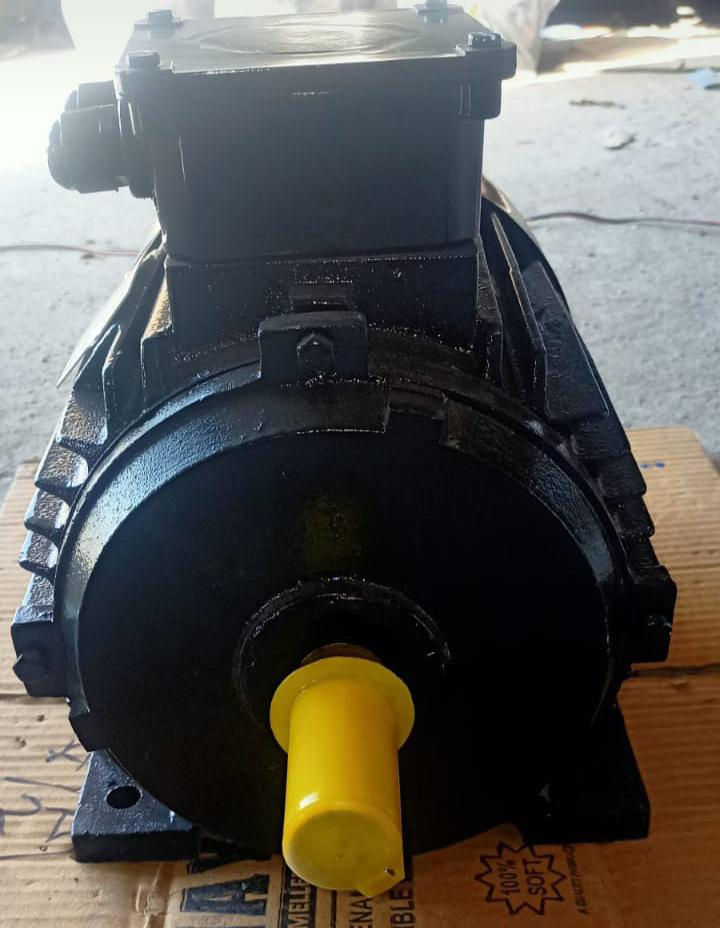
Most blower installations use a foot mounted motor on a common base frame or on a sliding rail that allows belt tensioning. Flange mounted motors are preferred where the fan casing or a bell housing carries the motor directly, keeping the assembly compact and the shafts aligned. We manufacture foot, flange, face and foot-cum-flange mountings, so the motor can be matched to your fan skid.
A few points to check on the drive side:
Belt drives put a radial load on the motor shaft. Avoid very small motor pulleys and over-tensioned belts, which shorten bearing life.
For direct coupling, align the shafts carefully with a flexible coupling. Misalignment is a common cause of vibration and bearing failure.
Balance the impeller. An unbalanced fan wheel transmits vibration straight into the motor bearings.
Keep the motor's cooling fan and fins clean. In dust collector and cement plant duty, dust build-up on the frame quickly raises winding temperature.
Starting Method, Current and Energy Saving
At 415 V, a 20 HP 3 phase motor typically draws in the region of 27 to 30 A at full load; always confirm the exact value from the motor nameplate. Direct-on-line starting draws several times that current, so for this rating most users choose a star-delta starter, and many electricity boards and plant electrical standards expect reduced-voltage starting at this size.
Star-delta starting reduces starting current to about one third of the DOL value. It suits fans well because a fan needs little torque at low speed. The motor must be suitable for delta connection at the supply voltage.
Soft starters give a smooth, stepless start and reduce mechanical shock on belts and couplings.
A variable frequency drive (VFD) is the best option when air flow must vary. Because fan power falls with the cube of speed, reducing speed instead of throttling with a damper can save a large share of energy at part load.
Set the overload relay to the nameplate current and choose a trip class that allows the fan's longer acceleration time. Fit single phasing protection on every fan motor.
For continuous fan duty, a higher efficiency motor (IE2 or IE3 class) usually repays its cost through lower running charges. Ask us about the efficiency class that suits your application.
Quick Checklist Before You Order
Fan absorbed power at the duty point, and the margin you want.
Fan speed and drive type: direct coupled or belt driven.
Required motor speed: 2880, 1440 or 960 RPM.
Mounting: foot, flange, face or foot-cum-flange, with shaft size if matching an existing fan.
Supply voltage and the starting method you plan to use.
Site conditions: ambient temperature, dust, moisture and whether the motor is indoors or outdoors.
Sharing these details with us lets our team recommend the correct motor the first time.
Buy a 20 HP 3 Phase Motor from Unicorn Engineers, Ahmedabad
Unicorn Engineers is an induction motor manufacturer in Ahmedabad, Gujarat, making single phase and 3 phase AC induction motors in foot, flange, face and foot-cum-flange mountings, along with brake motors and crane duty motors. We are ISO and MSME certified, our motors carry a 1-year warranty, and as an electric motor supplier in India we offer all-India delivery and dealer support for fan, blower and OEM customers.
Browse our full range on the Our Products page, or send us your fan details through our Contact page. For quick help, call or WhatsApp our sales team on +91 90337 48932. Phone and WhatsApp enquiries are welcome.
Visit us at 33, Gopal Charan Estate, Road No-5, Kathwada GIDC, Ahmedabad 382430.


Comments